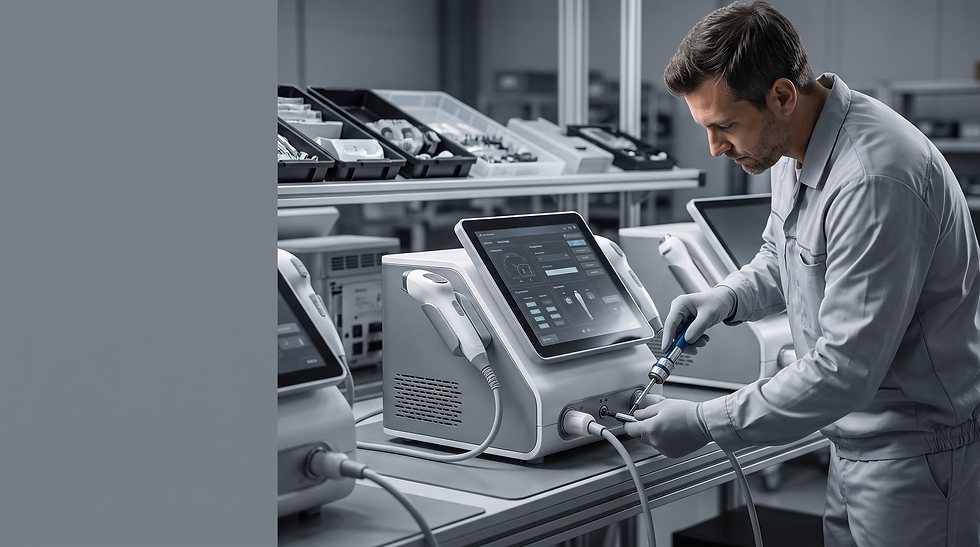
Shr Laser Hair Removal Machine: B2B Configuration Guide for Skin Rejuvenation Buyers

Selecting professional light-based equipment requires balancing clinical utility, hardware durability, and post-sale technical support. For a salon equipment buyer or aesthetic distributor evaluating a commercial shr laser hair removal machine, technical due diligence goes far beyond standard cosmetic casing. Whether expanding an aesthetic device line or upgrading multi-treatment treatment rooms, understanding factory qualification, component configuration, and quality assurance processes is essential to securing long-term return on investment.
Get OEM/ODM Quote
Key Takeaways for Sourcing Light-Based Aesthetic Systems
Optical configurations, sub-assembly component grades, and pulse-delivery stability determine clinical uptime and treatment comfort.
Sourcing goes beyond cosmetic branding; rigorous buyers audit factory traceability, sub-supplier qualification, and modular design before sample sign-off.
Commercial success depends on verifiable after-sales support, including technical documentation, field-replaceable spare parts, and structured warranty protocols.
Defining clear Request for Quotation (RFQ) specifications early prevents engineering revisions and alignment gaps during production.
Buyer Context: Aligning Equipment Selection with Business Models
Different commercial buyers approach equipment procurement with distinct operational goals and risk profiles:
Regional Distributors: Focus on stable sub-assemblies, spare-parts modularity, localized software interfaces, and distributor margin protection.
Aesthetic Equipment Importers: Prioritize component traceability, electrical safety compliance, factory testing records, and predictable logistics fulfillment.
Private Label Brands: Require consistent housing finishes, custom user interface graphics, specialized packaging, and synchronized accessory lines across multi-technology portfolios.
Multi-Location Salon Chains: Focus on operational uptime, intuitive operator workflows, standardized handpiece maintenance, and prompt service availability.
Recognizing your primary business objective allows you to define engineering criteria before engaging an OEM/ODM manufacturing partner.
Evaluating a Shr Laser Hair Removal Machine: Core Configuration Factors
Super Hair Removal (SHR) technology delivers high-repetition optical energy at lower fluence compared to traditional single-pulse flash systems. While often compared with a conventional ipl laser machine, high-throughput SHR systems place greater continuous demand on power supplies, optical filtering, and active cooling circuits.
Power Delivery and Energy Output
Stable in-motion treatments require high-capacity internal capacitors and industrial-grade power supply units capable of sustaining consistent output frequencies without thermal degradation or pulse drop-off.

Optical Filtration and Spectrum Management
High-purity sapphire optical crystal blocks and targeted multi-layer dielectric coatings ensure accurate wavelength isolation, protecting superficial epidermal layers while effectively targeting follicular and vascular structures.
Contact Cooling Architecture
Continuous motion requires integrated contact cooling. Professional systems employ dual thermoelectric cooling (TEC) modules paired with high-flow radiator loops to maintain constant sub-ambient tip temperatures throughout high-volume clinic schedules.
Manufacturing Workflow: From Product Brief to Production Readiness
Professional OEM/ODM projects follow an explicit phase-gate structure to guarantee mechanical and electrical alignment:
Market Brief & Requirements Definition: Finalizing clinical parameters, target price tier, UI language support, and chassis form factor.
Engineering Shortlist: Reviewing internal schematics, capacitor load ratings, fluid pump specifications, and optical block options.
Customization Specifications: Finalizing housing colorways, capacitive touchscreen dimensions, branded boot animations, and external labeling.
Sample Validation & Bench Testing: Conducting functional energy output verification, thermal endurance checks, and chassis fitment reviews.
Mass Production & Quality Control: Implementing standardized sub-assembly testing, wiring harness strain relief audits, and burn-in testing.
Pre-Shipment Verification: Auditing final packaging drop protection, accessory inventories, serial tracking labels, and technical manuals.
OEM/ODM Project Stage Matrix and Buyer Risk Mitigation
Project Stage | What to Confirm | Buyer Risk | Recommended Action |
Component Selection | Power supply wattage, cooling pump brand, sapphire grade | Sub-tier components failing under continuous daily duty | Require manufacturer bills of materials (BOM) transparency |
UI & Software Config | Language files, interface navigation, software interlocks | Inaccurate translations, confusing clinic workflows | Review simulator builds or interactive software video records |
Sample Approval | Handpiece weight, spot size alignment, tip cooling rates | Ergonomic strain, uneven optical output across spot | Inspect physical golden sample under functional load |
Packaging & Labeling | High-density foam inserts, serialized regulatory labels | Transit damage, customs clearance inspection delays | Request drop-test reports and verify draft label artwork |
After-Sales Setup | Common wear-item lists, repair manuals, training decks | Long downtime during field service calls | Pre-order modular replacement boards, filters, and flashlamps |
Supplier Audit Criteria: Manufacturing Capability and Traceability
A qualified aesthetic equipment supplier should demonstrate robust engineering practices across the entire manufacturing lifecycle:
Internal Engineering Communication: Direct access to mechanical, optical, and software engineers to resolve customization inquiries without commercial misinterpretation.
Sub-Assembly Traceability: Batch-level serial tracking for critical sub-assemblies, including optical handpieces, internal power boards, and hydraulic flow sensors.
Burn-In & Quality Verification: Standardized 24- to 48-hour continuous discharge and thermal monitoring procedures prior to final boxing.
Configuration Control: Strict engineering change notification (ECN) protocols preventing unannounced component substitutions across subsequent production batches.

Scope of Customization for Private-Label Device Portfolios
For commercial brands and enterprise distributors, private labeling involves end-to-end industrial and visual standardization:
Industrial Enclosures: Custom powder coating, injection-molded bezel accents, and unified industrial design language across multi-device lines.
User Interface (UI): Branded welcome screens, tailored treatment parameter menus, multi-lingual navigation, and customized preset profiles.
Handpiece & Accessory Detailing: Ergonomic handpiece shell finishes, custom cable strain relief collars, and custom optical spot adapters.
Packaging & Documentation: Heavy-duty flight cases or reinforced export cartons with fitted EVA foam, branded user guides, quick-start setup cards, and compliance plate templates.
Critical Procurement Risk Checklist
Before signing off on production contracts, verify that your sourcing team has addressed these essential technical risks:
Verify power supply capacity matches continuous pulse repetition requirements without thermal derating.
Confirm the exact optical material used in the handpiece waveguide (sapphire vs. standard optical glass).
Audit internal hydraulic pathways for corrosion-resistant tubing and high-reliability quick-connect couplings.
Validate software safety interlocks, including water flow, water temperature, and electrical ground sensors.
Ensure handpiece umbilical cables incorporate adequate internal strain relief for daily mechanical flexing.
Inspect sample unit internal wiring for professional grouping, heat-shrink insulation, and terminal labeling.
Review standard replacement intervals and availability for consumable xenon flashlamps and filtration cartridges.
Establish clear pre-shipment inspection (PSI) criteria and acceptable quality limits (AQL) prior to deposit.
Structuring an Aesthetic Equipment OEM RFQ
To receive an accurate and actionable technical quotation, compile an exhaustive Request for Quotation (RFQ) package including:
Target Market & Buyer Type: Regional salon distributor, multi-location aesthetic clinic, or brand importer.
Primary Application & Technology Scope: SHR high-repetition hair reduction, complementary vascular/pigment filters, or dual-handpiece configurations.
Technical Hardware Specifications: Preferred power output ratings, screen size, cooling method, and foot-switch style.
Branding & Customization Scope: Enclosure color matching, custom GUI graphics, localized instruction manuals, and branded flight cases.
Volume & Delivery Schedule: Initial evaluation sample quantity alongside projected annual order volume.
Support & Spare Parts Expectations: Initial spare parts buffer packages, field technical training materials, and warranty replacement terms.
By executing a thorough technical audit and clearly defining specification requirements, commercial buyers can build a reliable, high-performance light therapy device portfolio that ensures clinical efficacy and long-term brand equity.
FAQ
What components should be checked when auditing a shr laser hair removal machine?
Buyers should audit internal power supply capacity, capacitor bank quality, the water-cooling radiator loop, optical waveguide purity (sapphire crystal), and safety sensor interlocks for temperature and water flow.
How does an SHR system differ from a traditional ipl laser machine from an OEM sourcing perspective?
SHR systems operate at higher pulse repetition rates (often up to 10Hz) with lower per-pulse energy, placing substantially higher continuous thermal loads on the power supply, optical handpiece cooling modules, and xenon flashlamp compared to traditional single-shot IPL units.
What customization options are standard for private-label aesthetic equipment?
Standard private-label customization includes custom chassis paint and trim colors, branded GUI/software interfaces, custom-molded handpiece shells, localized user manuals, and customized heavy-duty transit cases.
What documentation and spare parts should be requested before mass production?
Buyers should secure comprehensive bills of materials (BOM), exploded-view technical service manuals, wiring schematics, and an agreed spare parts package containing replacement handpieces, filters, power boards, and optical crystals.
Develop Your Private-Label Aesthetic Equipment Portfolio
Share your target market, equipment category, branding requirements, and expected product-line structure. Stellayjoy helps distributors and aesthetic brands organize practical technical shortlists and customization planning before quotation.