808nm Standing Diode Laser Machine Hair Removal Treatment: Sourcing Guide

Selecting a high-performance laser platform requires balancing clinical throughput, continuous duty cycles, and field reliability. For US aesthetic equipment distributors and multi-location practice groups, introducing an 808nm standing diode laser machine hair removal treatment into a commercial product portfolio demands rigorous technical verification. Success is not determined solely by peak power ratings on a spec sheet, but by how well the device manages thermal dissipation, internal component accessibility, and total cost of ownership across years of daily operation in high-volume clinics.
Key Takeaways for Equipment Distributors
Standing console platforms offer superior chassis volume for industrial-grade compressors and water pumps, making them the standard choice for multi-room, continuous-operation clinics.
Real handpiece optical output depends directly on laser bar origin, diode packaging architecture, and duty-cycle stability under continuous pulse repetition.
Compressor-driven active cooling protects diode stacks from micro-channel thermal fatigue and prevents costly premature handpiece replacement.
Modular internal layouts with quick-disconnect fluid lines and isolated PCB compartments minimize field service technician time and warranty expense.
Distributor margins rely on clear spare parts availability, standardized sub-assemblies, and transparent OEM/ODM private-label engineering.
Buyer and Business Model Fit
Different aesthetic business models require distinct equipment specifications. Understanding these distinctions allows distributors to recommend the right hardware configuration to their client base.
High-Volume MedSpas and Clinic Chains
Large practices require continuous back-to-back treatment capabilities without thermal throttling. A standing console system delivers the physical space necessary for high-capacity liquid reservoirs, dual heat exchangers, and industrial thermoelectric cooling (TEC) assemblies. These components ensure that tip temperatures remain stable throughout a ten-hour operating day.
Boutique Practices and Expanding Aesthetic Suites
For facilities with limited square footage or multi-use treatment rooms, mobile footprint matters. While high-volume centers prefer standing units, distributors often pair them with a portable 808nm diode laser hair removal shrink pores machine to serve mobile practitioners, satellite locations, or entry-level aesthetic providers needing versatile face and body treatment menus.
Aesthetic Equipment Distributors and Private Label Brands
Distributors must prioritize serviceability, modular engineering, and customization flexibility. Sourcing platforms that share unified internal architecture reduces inventory overhead for replacement handpieces, filters, power supplies, and control boards.
Evaluating the 808nm Standing Diode Laser Machine Hair Removal Treatment Platform
When evaluating a floor-standing 808nm platform, technical validation should focus on the optical emitter stack and the thermal management subsystem.
Laser Bar Output and Optical Coupling
Diode stack longevity is determined by the quality of the laser bars and their packaging. Sourcing teams should verify whether the generator utilizes micro-channel or macro-channel water-cooled diode arrays. Micro-channel arrays offer efficient heat transfer but require strict deionized water filtration to prevent clogging. Macro-channel arrays provide greater tolerance to cooling variations, making them highly reliable across diverse operating environments.

Equally important is optical energy uniformity. High-grade optical waveguides and gold-coated reflective cavities prevent hot spots across the spot area, delivering homogenous fluence that protects epidermal tissue while maximizing follicular thermal accumulation.
Thermal Management and Continuous Duty Cooling
Thermal management separates commercial-grade platforms from budget assemblies. A robust standing unit should incorporate a multi-stage cooling circuit:
Refrigeration Compressor Unit: Actively maintains circulating water temperatures between 20°C and 25°C, preventing thermal shutdown regardless of ambient room temperature.
High-Flow DC Water Pump: Delivers consistent flow rates to remove heat immediately from the diode junction.
Sapphire Contact Tip with TEC Integration: Maintains sub-zero contact cooling at the handpiece tip to enhance patient comfort and prevent epidermal thermal injury.
Commercial Evaluation: Serviceability and Total Cost of Ownership
Equipment downtime damages clinic revenue and increases distributor warranty costs. Evaluating a device's serviceability before placing volume orders protects your bottom line.
Modular Architecture and Component Accessibility
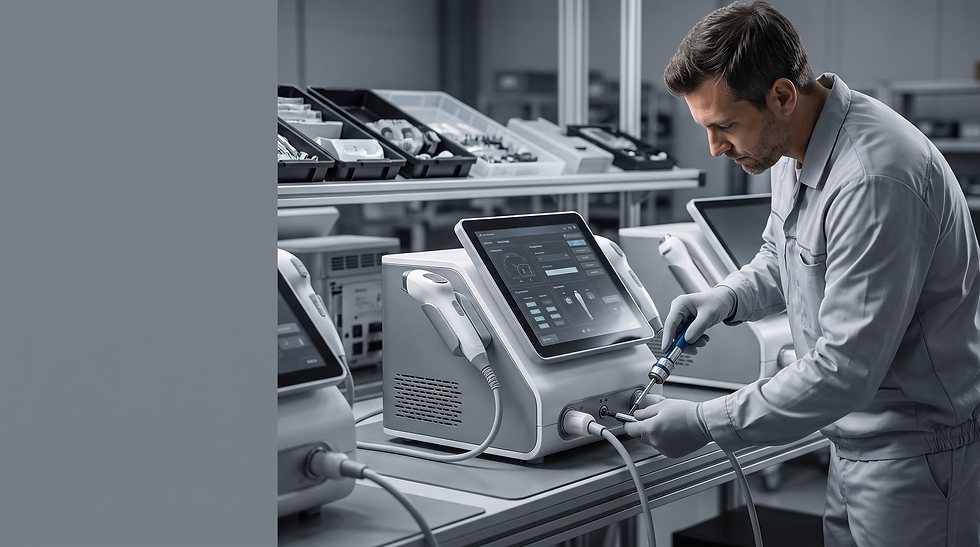
A commercial diode system must feature organized internal zoning. Fluid circuits should be physically isolated from high-voltage power supplies to prevent liquid ingress during filter replacements or transport. Quick-disconnect fittings and accessible side panels allow technicians to perform routine water filter changes or pump inspections in under thirty minutes.
Consumables and Handpiece Shot Economics
Unlike aesthetic modalities that rely on per-treatment tip disposables, diode laser profitability depends on handpiece shot longevity. Distributors should verify guaranteed pulse thresholds, replacement handpiece exchange programs, and whether the system requires proprietary fluid additives or standard deionized water.
Distributor Sourcing Decision Matrix
Use this matrix during factory audits or technical sample evaluations to assess platform risks before procurement.
Evaluation Criterion | Commercial Importance | Verification Method | Distributor Risk Level |
Laser Bar Origin & Quality | Directly governs pulse stability, emission efficiency, and diode stack lifespan. | Request component sourcing documentation, diode bar manufacturer specifications, and stack wattage test curves. | High: Substandard bars lead to premature handpiece failure and excessive warranty claims. |
Compressor Cooling Integration | Ensures continuous operation during peak clinic volume without thermal pauses. | Conduct continuous 60-minute firing test at maximum repetition rate; monitor water temperature curves. | High: Inadequate cooling causes automatic thermal shutoff, disrupting clinic workflow. |
Internal Fluid Isolation | Prevents electrical shorts and simplifies routine fluid and filter maintenance. | Inspect internal chassis layout during sample evaluation; check physical separation of wet and dry bays. | Medium: Poor internal zoning increases technician labor hours and repair complexity. |
Calibration & Power Stability | Ensures consistent optical fluence output matching on-screen UI parameters. | Measure optical output using an external energy meter across various pulse widths and frequencies. | High: Fluence drift results in ineffective treatments or unexpected adverse events. |
Modular Wiring & Harnessing | Reduces troubleshooting time and allows localized board replacements. | Check for labeled automotive-grade wiring harnesses, standardized terminals, and diagnostic test points. | Medium: Spaghetti wiring creates intermittent electrical faults that are difficult to diagnose. |

Portfolio Planning for Aesthetic Equipment Distributors
A floor-standing 808nm diode platform serves as the anchor system in any body and hair removal catalog. It provides the reliable, high-margin foundation that clinics purchase first when establishing treatment menus.
When positioning this equipment, distributors should provide clear tiered options:
Core Hair Removal Anchor: Standing 808nm diode system optimized for continuous duty cycles, large spot sizes, and maximum patient throughput.
Secondary Facial/Specialty Station: Compact or multi-wavelength units for boutique operators, fine hair protocols, and vascular/pigment combination offerings.
Adjacent Aesthetic Modalities: Complementary platforms such as RF microneedling and body contouring devices to expand average account value across existing customer relationships.
Supplier Screening Questions for Factory Audits
Before finalizing purchase orders with an OEM/ODM manufacturer, submit these technical vetting questions:
What is the rated optical power output of the diode stack inside the handpiece, and what is the electrical input power of the main power supply?
Does the chassis utilize an active compressor refrigeration cycle, a standard radiator fan, or a standalone thermoelectric heat exchanger?
What specific deionized water filtration micron rating and conductivity thresholds are required for routine maintenance?
Are the handpiece optical cables and water lines reinforced with industrial silicone jackets to prevent internal hose crimping?
What diagnostic error codes are logged by the control board to troubleshoot fluid flow errors, temperature spikes, and overcurrent conditions?
What is the standardized procedure for exchanging or refurbishing depleted handpiece diode stacks?
Can the graphic user interface (GUI), casing colorway, and boot screen be fully customized under private-label OEM terms?
What critical spare parts kit (pumps, power supplies, flow sensors, replacement filters) is stocked for immediate distributor dispatch?
Distributor RFQ and Quotation Checklist
When requesting detailed quotations and sample units from manufacturing partners, provide comprehensive commercial requirements to receive an accurate quote:
Target Market & Voltage Requirements: Specify standard US power inputs (220V single-phase or 110V dedicated lines) and necessary regional compliance documentation.
Expected Annual Order Volume: Outline initial evaluation batch sizes and projected quarterly unit forecasts.
Handpiece Configuration: Define required spot sizes, optical stack wattages (e.g., 800W, 1200W, or 1600W handpieces), and single versus dual-applicator configurations.
Branding and Customization Depth: Specify chassis color palettes, logo placement specifications, custom software skins, and localized user manual requirements.
After-Sales Support Expectations: Clarify technician training resources, engineering documentation access, and warranty replacement terms for optical sub-assemblies.
For distributors developing a dedicated product line, exploring tailored OEM/ODM aesthetic equipment options ensures that hardware architecture, exterior industrial design, and firmware match your exact brand positioning.
FAQ
What is the primary advantage of a standing diode laser over a portable unit?
A standing console platform provides significantly larger internal chassis volume, enabling the use of heavy-duty refrigeration compressors, larger water reservoirs, and dual heat exchangers. This advanced cooling infrastructure allows high-volume MedSpas to run continuous back-to-back treatments all day without encountering thermal throttling or needing cooling pauses.
How should distributors verify real handpiece output versus marketing claims?
Distributors should request verified diode bar manufacturer data sheets and measure actual optical output using an external calibrated laser power meter across various pulse widths and frequencies. Comparing the optical stack wattage against the capacity of the internal DC power supply also confirms whether the system can deliver sustained peak energy.
What after-sales service capabilities should a distributor establish before launch?
Distributors should maintain a local inventory of high-turnover service parts including water filters, flow sensors, quick-connect fittings, and spare power supply units. Technicians should be trained to perform fluid flushes, calibrate optical energy, and swap modular sub-assemblies to resolve client support requests without shipping complete units back to the factory.
Can the 808nm standing diode laser platform be customized under private label?
Yes, professional OEM/ODM manufacturers can customize the exterior chassis styling, housing colors, interface software, boot graphics, and packaging. Distributors should provide their target branding guidelines and volume projections during the initial RFQ stage to align tooling and software requirements.
Build Your Custom Diode Laser Equipment Line
Tell us your target market, clinic customer profile, preferred handpiece configuration, and branding requirements. Stellayjoy helps distributors and aesthetic brands configure reliable, service-ready diode laser platforms with tailored OEM/ODM engineering support.