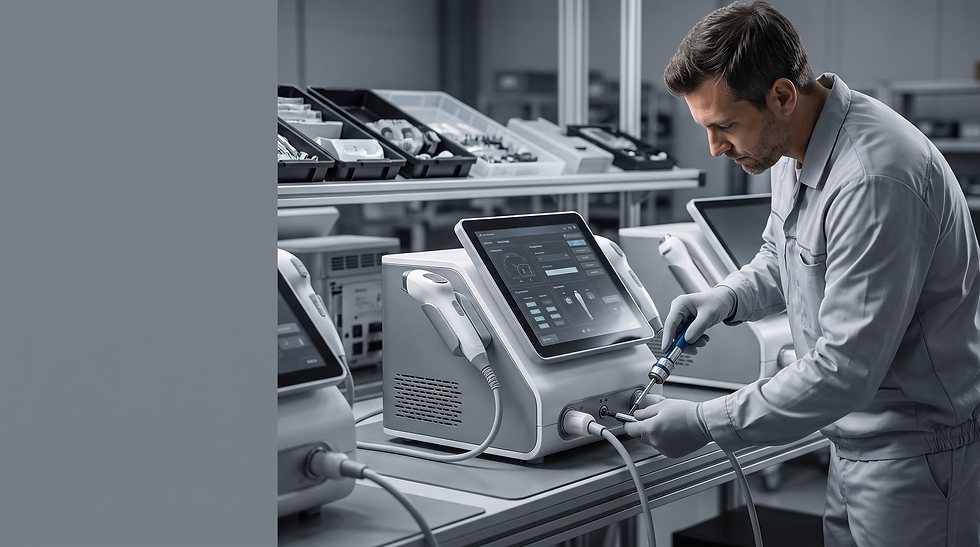
Pico Second Laser Sourcing: OEM Supplier Audit & QC Guide

Sourcing a professional pico second laser for clinic expansion, regional distribution, or private-label commercialization requires technical rigor beyond reviewing brochure specifications. Tattoo removal clinic buyers and aesthetic equipment importers must evaluate optic stability, energy calibration protocols, component traceability, and post-shipment engineering support to ensure operational reliability.
Key Takeaways for Laser Equipment Buyers
Sourcing high-performance pico laser equipment requires verifying optic bench alignment, cooling architecture, and articulated arm balance rather than relying on unverified peak power marketing figures.
Factory audits must inspect component batch traceability, sub-assembly testing records, and burn-in testing protocols to mitigate clinical downtime.
Private-label programs should lock down user interface (UI) workflows, multi-language localization, optical chassis design, and branded packaging during the pilot stage.
A complete request for quotation (RFQ) must detail target clinical workflows, optical spot profile requirements, servicing expectations, and technical training deliverables.
Buyer Context: Aligning Sourcing Strategy with Business Models
Procurement requirements for laser tattoo removal and pigment treatment platforms vary significantly across buyer profiles:
Tattoo Removal & Medical Aesthetic Clinics: Clinical owners prioritize handpiece ergonomics, consistent spot delivery, intuitive touchscreen workflows, and fast access to replacement optics to prevent revenue loss from unexpected downtime.
Regional Distributors: Importers require strict configuration control, standardized spare parts inventories, complete technical documentation for local service technicians, and dependable after-sales engineering channels.
Private-Label Aesthetic Brands: Brand developers focus on distinctive industrial housing aesthetics, custom graphical user interfaces, branded packaging, and reproducible quality controls across repeat production runs.
Multi-Location MedSpa Groups: Corporate operators need unified device operation profiles across locations, fleet maintenance predictability, and standard operating procedure (SOP) onboarding materials for rotating clinical staff.
Pico Second Laser OEM/ODM Project Workflow
Executing a structured OEM or ODM project ensures clinical specifications translate accurately into production reality across eight critical phases:
Market Requirement Definition: Define target clinical indications, wavelength requirements (e.g., 1064 nm, 532 nm, optional fractional handpieces), target duty cycles, and target operator demographics.
Product Shortlisting & Architecture Review: Assess internal chassis layouts, power supply ratings, water-to-air heat exchanger capacity, and optical arm articulation.
Customization & Configuration Matrix: Finalize hardware enclosure colors, brand badging, graphical UI assets, default energy parameters, and interface languages.
Engineering Sample Build: Assemble pre-production units following precise configuration drawings and wiring schematics.
Sample Verification & Clinical Parameter Audit: Confirm pulse duration stability, beam profile uniformity, spot size consistency, and thermal recovery.
Batch Production & Inline Quality Checks: Execute standardized optical bench assembly, wiring loom isolation, and multi-hour burn-in cycles.
Pre-Shipment Inspection (PSI): Conduct incoming component audits, finished unit energy output metering, electrical safety tests, and drop-tested crating verification.
Logistics, Spares & Field Support: Dispatch serialized systems alongside designated critical spare parts, technical service manuals, and clinician training guides.
Stage-by-Stage Verification and Risk Management
The following matrix outlines essential verification milestones, potential procurement risks, and recommended actions across the device development lifecycle:

Project Stage | What to Confirm | Buyer Risk | Recommended Action |
1. Specification & RFQ | Wavelength options, spot size adjustability, articulated arm balance, electrical requirements | Incompatible clinic power or mismatched clinical capabilities | Issue a comprehensive technical RFQ defining pulse parameters and utility demands |
2. Core Component Audit | Laser cavity origin, optical mirror coatings, cooling pump grade, power supply ratings | Premature optical degradation or overheating during busy clinic days | Request component provenance documentation and cooling circuit flow diagrams |
3. UI & Firmware Setup | Language localization, software logic, parameter memory presets, service mode access | Operator confusion, UI lockups, or untraceable error codes | Review screen-by-screen wireframes and test firmware navigation during prototype review |
4. Prototype Verification | Energy output consistency across spot sizes, beam homogeneity, handpiece weight | Fluctuating treatment fluence and clinician wrist fatigue | Measure output energy across continuous firing sequences before tooling release |
5. Production & Burn-In | Continuous pulse testing, thermal equilibrium limits, wiring harness quality | Early component failure within initial months of clinical deployment | Mandate verifiable burn-in test logs for each serialized unit prior to packing |
6. Packaging & Spares | Reinforced flight cases, optic storage humidity protection, critical spare parts | Shipping shock damage, misaligned optics, or prolonged repair downtime | Require drop-tested flight cases and bundle initial spare optics, fuses, and seals |
Supplier Evaluation: Factory Capability, QC, and Traceability
When evaluating a manufacturing partner for advanced aesthetic laser systems, buyers must inspect five foundational operational pillars:
1. Optical Assembly & Cleanliness Standards
Laser cavity integration requires controlled assembly zones to prevent particulate contamination on mirrors, crystals, and lenses. Inquire how the factory manages dust mitigation, static discharge, and precision optical alignment during chassis integration.
2. Inline Quality Control & Energy Calibration
Reliable manufacturers measure pulse-to-pulse energy stability using calibrated energy meters and beam profiling tools across varied repetition rates. Verify that output energy calibration is documented for every spot size increment on each production unit.
3. Sub-Assembly Traceability
Every major module—including high-voltage power supplies, simmer boards, cooling pumps, and articulated arms—should carry unique serial identifiers linked to the master device serial record. Traceability accelerates troubleshooting if component batches require field servicing.
4. Pre-Shipment Inspection Protocols
Before dispatch, finished machines must undergo rigorous functional inspections. This includes checking emergency stop circuit response, interlock switches, water flow and temperature warning sensors, touchscreen responsiveness, and outer enclosure finish.
5. Technical Documentation and Service Readiness
A capable supplier provides clear schematics, exploded parts diagrams, error code lookup matrices, and step-by-step optical realignment guides to support local biomedical engineers.

Customization Scope for Private-Label Platforms
Private-label commercialization enables distributors and clinic chains to build distinct brand equity through focused customization:
Housing & Industrial Enclosures: Custom powder coating, injection-molded panel colors, and metallic trim accents aligned with corporate brand palettes.
Console Graphical User Interface (GUI): Custom welcome screens, company color themes, streamlined clinical selection menus, and multi-language firmware localization.
Apparatus Labeling & Serialization: Metal asset plates, technical warning labels, and laser aperture identification plates compliant with regional import formats.
Protective Packaging: Custom heavy-duty flight cases with high-density laser-cut foam inserts, custom exterior stenciling, and dedicated accessory compartments.
Handpiece & Accessory Integration: Ergonomic articulated arm balancing, zoom handpiece finishes, and dedicated storage brackets tailored to clinic workflow.
Project Risk Checklist for Equipment Importers
Review these critical operational checkpoints prior to signing mass production authorizations:
Laser cavity cooling architecture is tested for sustained high-repetition-rate operation.
Articulated arm joints move smoothly across all clinical treatment angles without drift.
Graphical user interface text is verified by native-speaking clinical reviewers.
Handpiece spot size adjustments accurately communicate with internal software limits.
Calibration logs confirm output energy matches on-screen clinical fluence values.
High-voltage isolation and grounding circuits meet standard electrical safety guidelines.
Protective packaging withstands multi-axis freight vibration and transit shock.
Dedicated spare parts packages (filters, O-rings, mirrors, fuses) are specified for delivery.
Structuring Your OEM/ODM Request for Quotation (RFQ)
To receive an accurate and actionable engineering proposal from a manufacturer, provide a structured RFQ covering:
Target Market & Buyer Type: Specify whether you operate as a distributor, clinic group, or private-label brand.
Clinical Application Profile: List core treatments (multi-color tattoo removal, pigmented lesion toning, skin rejuvenation).
Desired Hardware Configuration: Note wavelength requirements, articulated arm specifications, screen size, and footprint limits.
Branding & Localization Scope: Clarify exterior color requests, logo placement guidelines, and necessary software languages.
Target Volume & Rollout Timeline: Outline initial evaluation sample needs and anticipated annual production schedules.
Post-Sales Service Expectations: State required warranty support structure, technician training formats, and spare parts availability timelines.
FAQ
What core technical elements should buyers verify when sourcing a pico second laser?
Buyers should inspect the optical cavity stability, cooling system heat dissipation, articulated arm balance, energy calibration consistency across spot sizes, and component batch traceability.
What can be customized on a private-label pico laser equipment line?
Customization options include external housing colors, graphical user interface branding, software languages, custom flight cases, branded nameplates, and tailored handpiece accessory packages.
What documentation should an OEM equipment manufacturer provide before dispatch?
Manufacturers should provide individual unit calibration test reports, electrical safety test logs, comprehensive user and service manuals, wiring schematics, and detailed error code troubleshooting guides.
How should distributors plan spare parts inventories for aesthetic laser devices?
Distributors should secure an initial inventory of consumable optical lenses, protective windows, replacement water filters, cooling pump assemblies, and power supply boards alongside the primary shipment.
Start Your Laser Sourcing Project
Share your target clinical indications, equipment specifications, branding requirements, and projected rollout schedule. Stellayjoy can assist in organizing technical shortlists, configuration reviews, and sample evaluation discussions.