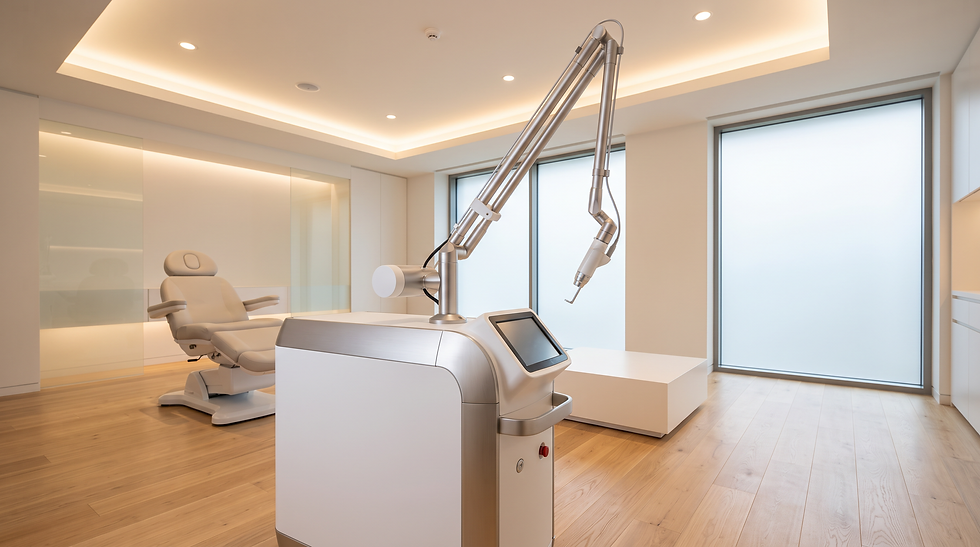
Pico Laser Equipment: MedSpa Guide to ROI, TCO, and Technical Sourcing

Investing in energy-based aesthetic devices is one of the most critical capital allocation decisions a practice leader can make. For medical spa operators and aesthetic clinic directors, acquiring advanced pico laser equipment represents a significant opportunity to capture market demand across benign pigment clearance, tattoo removal, and facial revitalization. However, evaluating aesthetic capital equipment requires balancing initial price considerations against multi-year operating economics. Long-term operational profitability is rarely determined by the purchase invoice alone; rather, it hinges on total cost of ownership, daily clinical reliability, component lifespans, and direct factory support.
Selecting a high-efficiency picosecond laser machine involves looking past superficial marketing specifications to examine internal optical architecture, power supply stability, consumable constraints, and warranty frameworks. When clinic leaders understand the full lifecycle cost of energy-based equipment, they can accurately structure treatment menus, calculate patient payback horizons, and ensure consistent clinical uptime across high-volume schedules.
Deconstructing Total Cost of Ownership for Pico Laser Equipment
Total Cost of Ownership (TCO) provides the true financial baseline for aesthetic technology investments. In high-demand treatment environments, focusing exclusively on acquisition expenditure leaves clinics vulnerable to hidden ongoing fees, costly optical consumables, and expensive service maintenance contracts. A rigorous TCO model breaks down expenditures into four distinct financial pillars over a five-to-seven-year operational lifecycle.
Capital Acquisition and Financing Structure: Initial purchase prices vary drastically depending on brand markups, distribution layers, and custom factory configurations. Direct sourcing models eliminate multi-tiered intermediary markups, lowering the initial capital threshold and accelerating the break-even timeline for new treatment rooms.
Consumable and Optical Handpiece Overhead: Many legacy device manufacturers implement recurring operational tollgates, such as mandatory RFID pulse cards, locked per-treatment activation codes, or consumable handpiece tip replacements. Over several thousand patient treatments, locked consumable fees erode clinic profit margins.
Preventative Maintenance and Calibration Costs: Precision optoelectronic devices require predictable maintenance, including closed-loop cooling fluid flushes, laser cavity mirror alignments, and optical energy output verifications. Sourcing devices with modular internal layouts reduces routine maintenance hours and field-service labor costs.
Downtime and Opportunity Cost: An inoperable workstation creates an immediate cascade of canceled client appointments, lost revenue, and brand friction. Evaluating mean time between failures (MTBF) and component availability is vital for maintaining steady cash flow.

Financial Comparison: Direct OEM Sourcing vs. Legacy Distribution
The following matrix outlines how equipment procurement channels, consumable architectures, and service structures directly affect financial performance and operational flexibility in clinical practices.
Financial & Operational Dimension | Proprietary Distributor Model | Direct B2B OEM / ODM Model | Strategic Impact on MedSpa Operations |
Initial Acquisition Capital | Substantial multi-tiered distributor markup | Factory-direct pricing structure | Reduces upfront capital exposure and shortens capital recovery time |
Shot & Consumable Structure | Proprietary RFID cards or per-pulse fees | Open optical platform with zero per-pulse fees | Maximizes net margin per patient treatment session |
Modular Replacement Architecture | Closed proprietary sub-assemblies | Standardized modular electronic components | Minimizes technical service labor hours and simplifies parts dispatch |
Chassis & Software Customization | Locked manufacturer branding and presets | Private label, custom UI, and housing options | Builds unique clinic brand equity and differentiated market positioning |
Ongoing Technical Support Access | Third-party service dispatch with tier delays | Direct access to factory engineering and documentation | Delivers faster troubleshooting guidance and calibration support |
Warranty & Component Availability | Costly recurring annual service contracts | Direct manufacturer warranty and spare parts inventory | Keeps ongoing operational budgets predictable and manageable |
Optical Engineering and Quality Control Standards
The clinical consistency and daily durability of picosecond laser platforms depend directly on factory-level engineering and quality control protocols. Because ultra-short pulse generation demands extreme optoelectronic precision, MedSpa buyers should review manufacturing procedures before committing capital.
Cleanroom Assembly Protocols: Precision laser cavities, articulating arm mirrors, and beam-shaping optical elements must be assembled in dust-free cleanroom environments. Microscopic contaminants on optical lenses can cause thermal absorption hotspots, resulting in premature lens cracking or energy degradation.
Pulse Energy and Beam Profile Verification: Rigorous quality assurance requires factory testing of beam uniformity and energy density across all supported spot sizes. Top-hat beam profiles prevent localized hot spots, ensuring uniform energy delivery across treatment areas.
Continuous Pulse Stress Testing: Before factory release, reliable devices undergo extended aging cycles where laser modules fire tens of thousands of test pulses. This stress-testing phase identifies early diode or optical anomalies before the workstation arrives at your facility.
High-Capacity Closed-Loop Cooling: Thermal management directly impacts operational stability during back-to-back treatment sessions. Industrial-grade water circulation pumps, paired with efficient radiators and real-time flow sensors, prevent optical cavity overheating and system thermal shutdowns.
Evaluating MedSpa Workflow, Ergonomics, and Versatility
Beyond technical specifications and capital expenditures, equipment must integrate seamlessly into daily clinical workflows. MedSpa owners must assess how handpiece ergonomics, counterbalanced articulated arms, and user interface designs influence practitioner efficiency and operator fatigue.

Articulated Optical Delivery Arms: Precision multi-joint articulated arms balanced by counterweights minimize physical strain on practitioners during lengthy tattoo removal or pigment sessions. Smooth articulation ensures consistent handpiece positioning and spot perpendicularity.
Multi-Wavelength Versatility: Sourcing systems capable of delivering multiple wavelengths enables treatment across a broader range of pigment depths and tattoo ink colors without requiring secondary capital purchases.
Intuitive Software Presets: Digital interfaces featuring customizable parameter memories allow clinics to standardize treatment protocols across different staff members, ensuring reproducible clinical results and streamlined staff onboarding.
Chassis Mobility and Space Efficiency: Compact workstation footprints equipped with heavy-duty locking casters permit effortless movement between treatment suites, maximizing room utilization throughout the business day.
Mitigating Risk: Warranty Execution, Parts Dispatch, and OEM Collaboration
Protecting your equipment investment requires establishing a reliable partnership with your manufacturing supplier. When evaluating equipment providers, MedSpa owners should prioritize transparency regarding spare parts availability, remote diagnostic capabilities, and warranty terms.
Direct collaboration with an established OEM/ODM manufacturer ensures rapid access to technical schematics, replacement power modules, optical assemblies, and calibration guidelines. Eliminating third-party middle tiers ensures direct communication with factory engineers, allowing clinic technical staff to resolve operational questions swiftly and maintain peak device performance.
To review technical specifications, explore customized chassis configurations, or request direct manufacturing quotations for your aesthetic practice, connect with our B2B technical team through our OEM/ODM Services or send your requirements directly via our Contact Portal.
FAQ
What primary operational variables determine the ROI of pico laser equipment?
Return on investment is driven by initial acquisition cost, daily patient volume, average treatment price, absence of mandatory per-shot consumable fees, and minimal operational downtime.
How do open optical platforms lower operating costs compared to proprietary systems?
Open optical platforms eliminate proprietary RFID cards and per-treatment shot activation fees, allowing clinics to keep 100% of treatment revenue after initial equipment and maintenance expenses.
Why is factory pulse stress testing critical for aesthetic laser systems?
Extended pulse stress testing verifies optical alignment, beam profile uniformity, and thermal cooling stability under high-load conditions, preventing early component failure during clinical operations.
What maintenance is required to ensure long-term picosecond laser reliability?
Routine maintenance includes regular cooling fluid inspections, air filter cleaning, optical window checks, and periodic output calibration to ensure consistent energy delivery over years of use.
Configure Your Practice Laser Platform
Connect with our engineering specialists to discuss tailored optical configurations, direct B2B pricing, and OEM/ODM private label options for your MedSpa.