
The Heart of Light: Mastering the Laser Diode Manufacturing Process in our 2026 Class 10,000 Lab

In the 2026 medical aesthetic market, the "glossy brochure" is no longer enough to convince elite clinic owners. They want to know what happens at the chip level. Why do some machines lose 30% of their energy after six months, while others remain stable for years? The answer lies in the Laser Diode Manufacturing Process.
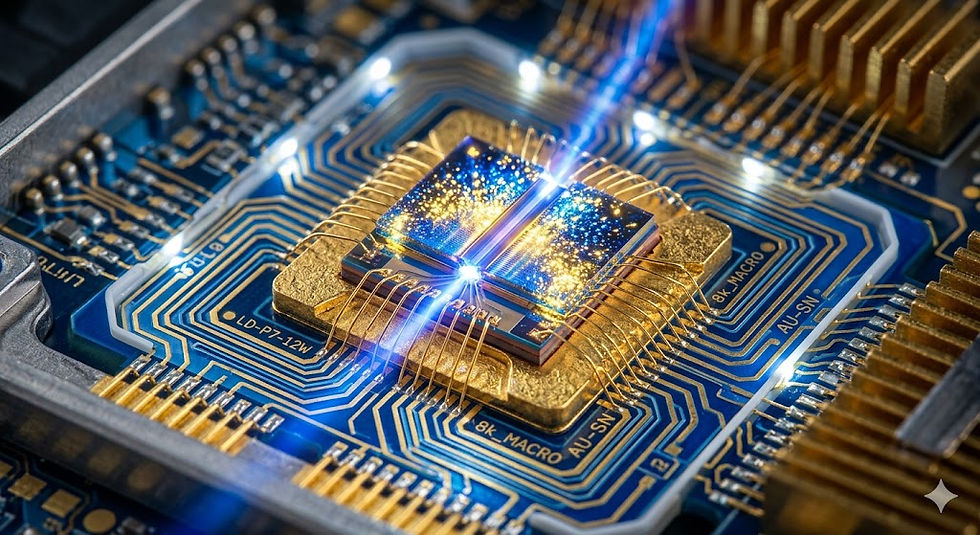
At our facility, we control the environment, the materials, and the physics of light. Here is the data-backed reality of how we build the "heart" of your device using copy-ready technical specifications.
1. Starting at the "Heart": How the Laser Diode Manufacturing Process Dictates Lifespan
The greatest enemy of a laser diode is heat. The way the laser chip (the emitter) is bonded to the copper heat sink determines how fast heat can be evacuated. In our Laser Diode Manufacturing Process, we have moved beyond "Soft Solder" (Indium) to "Hard Solder" (Gold-Tin).
Data Comparison: Indium vs. Gold-Tin (AuSn)
Parameter | Indium (Soft Solder) | Gold-Tin (AuSn Hard Solder) | Clinical Impact |
Thermal Resistance (Rth) | ~ 0.5 K/W | < 0.3 K/W | Faster cooling of the chip. |
Melting Point | 156°C | 280°C | Prevents solder re-melting under load. |
Electromigration (Creep) | High Risk | Zero Risk | Prevents chip displacement. |
Guaranteed Shot Count | 10 - 20 Million | 100 Million+ | 5x longer ROI for the clinic. |
By reducing the Thermal Resistance (Rth), we ensure the Junction Temperature (Tj) remains low. The physics is simple: for every 10°C decrease in Tj, the lifespan of the diode effectively doubles.
2. Environment Control: The Data Behind Class 10,000 Purity
A single particle of dust is a giant in the world of micro-optics. If a particle lands on the laser facet during the Laser Diode Manufacturing Process, it causes a "Catastrophic Optical Damage" (COD) event.

Cleanroom Standard Comparison
We operate under ISO 7 (Class 10,000) standards, but our core chip-mounting stations are further shielded to ISO 5 (Class 100).
Particle Size (>=) | Class 100,000 (Standard Factory) | Class 10,000 (Our Lab) | Class 100 (Our Chip Station) |
0.5 micrometers | 100,000 | 10,000 | 100 |
5.0 micrometers | 700 | 70 | 0 |
Failure Rate | 3% - 5% | < 0.1% | Near Zero |
This level of purity ensures that the "facet" of the laser remains pristine. In 2026, where laser power densities exceed 2,000 W/cm², even a sub-micron particle would vaporize instantly, causing a pinhole burn that leads to total diode failure.
3. The Power Efficiency Formula: Wall-Plug Efficiency (WPE)
In our Laser Diode Manufacturing Process, we don't just focus on power; we focus on efficiency. WPE is the ratio of optical output power to electrical input power.
WPE = (P_out / (V x I)) x 100%
Industry Average: 40% - 45% (meaning 55% of energy is wasted as heat).
Our 2026 Benchmark: 62% - 65%.
Higher WPE means your machine draws less electricity from the wall, generates significantly less waste heat, and allows for much longer continuous working hours without the "overheat" alarm ever triggering—even in a 30°C treatment room.
4. The "Indium-Free" Advantage for High-Frequency Use
Many low-cost manufacturers use Indium because it is cheap and easy to work with. However, Indium is prone to "Oxygen-induced thermal fatigue." Over time, the Indium layer oxidizes and detaches from the chip, causing the energy to drop.

Our Laser Diode Manufacturing Process is strictly Indium-Free. We use a proprietary multi-layer thin-film metallization process that ensures the bond between the chip and the gold-plated heat sink is atomic and permanent. This is why we can confidently offer an unlimited shot warranty while others cap theirs at 10 or 20 million pulses.
Frequently Asked Questions (FAQ)
Q1: How does "Hard Solder" affect the daily operation of my clinic?
A: It means you can run the machine at 10Hz (10 shots per second) all day long without the energy dropping. Soft-solder machines often need to "rest" every few hours to prevent the solder from softening.
Q2: Is a Class 10,000 lab necessary for the whole machine or just the diode?
A: The diode must be produced in this environment. While the final assembly of the machine's outer shell can happen in a standard clean environment, the "heart" (the laser stack) is sealed within our ISO 7 facility to ensure no internal contamination.
Q3: Does the WPE (Efficiency) affect the patient's experience?
A: Yes. Higher efficiency means the cooling system (Sapphire tip) doesn't have to fight against waste heat. This results in a much colder, more comfortable tip for the patient, even at high energy settings.
Conclusion: Engineering the Standards of 2026
Reliability is not a marketing term; it is a measurable result of a superior Laser Diode Manufacturing Process. By investing in hard-solder technology and ISO-certified environments, we provide a tool that is not only powerful but mathematically designed to last.
When you control the physics, you control the profit.
[CTA: Request our "2026 Diode Reliability Whitepaper" for full thermal analysis and Rth data sheets.]


