
How to Verify FDA Cleared Microneedling Devices Before Importing

Importing medical aesthetic equipment into the United States carries rigorous regulatory responsibilities. For distributors, MedSpa chains, and equipment importers, bringing in non-compliant devices can lead to costly border detentions, FDA import alerts, severe financial penalties, and irreversible brand damage.
Microneedling systems—including automated pen systems and motorized radiofrequency (RF) microneedling platforms—are scrutinized closely by the US Food and Drug Administration (FDA) and US Customs and Border Protection (CBP). Knowing how to accurately verify FDA cleared microneedling devices before placing purchase orders or shipping freight is vital for maintaining an uninterrupted, legally sound supply chain.
This guide breaks down the regulatory classification of microneedling technology, details the official verification workflow using FDA public databases, and outlines key red flags to look for during supplier due diligence.
Understanding FDA Classification for Microneedling Systems
The FDA regulates aesthetic microneedling devices based on their mechanism of action, penetration depth, and marketing claims. Misinterpreting these categories is one of the most common pitfalls for US importers.
Aesthetic vs. Medical Device Distinction
Under FDA guidance, a microneedling instrument is categorized as a medical device if it penetrates the living layers of the skin (dermis) to affect the structure or function of the body, or if it makes therapeutic and clinical claims such as treating acne scars, wrinkles, surgical scars, or stretch marks. These instruments are regulated as Class II medical devices and require FDA 510(k) premarket notification clearance prior to commercial distribution in the US.
Conversely, basic cosmetic dermarollers or micro-exfoliation tools that only touch the stratum corneum and make simple exfoliation claims may fall outside Class II medical device requirements, provided they make no medical or structural claims. However, professional powered microneedling pens and RF microneedling systems distributed to clinics and MedSpas almost universally require premarket clearance.
RF Microneedling vs. Mechanical Microneedling
Radiofrequency (RF) microneedling systems introduce thermal energy alongside physical needle penetration to stimulate dermal coagulation. Because of the combined thermal and mechanical mechanisms, these units carry distinct product codes and require robust electrical safety, electromagnetic compatibility (EMC), and clinical safety validations under their 510(k) submissions.
How to Verify FDA Cleared Microneedling Devices Step by Step
When evaluating a global OEM/ODM manufacturer or foreign supplier, you must independently cross-reference the supplier's credentials across public FDA databases. Do not rely solely on certificates provided as PDF attachments.
Follow this five-step workflow to verify compliance:
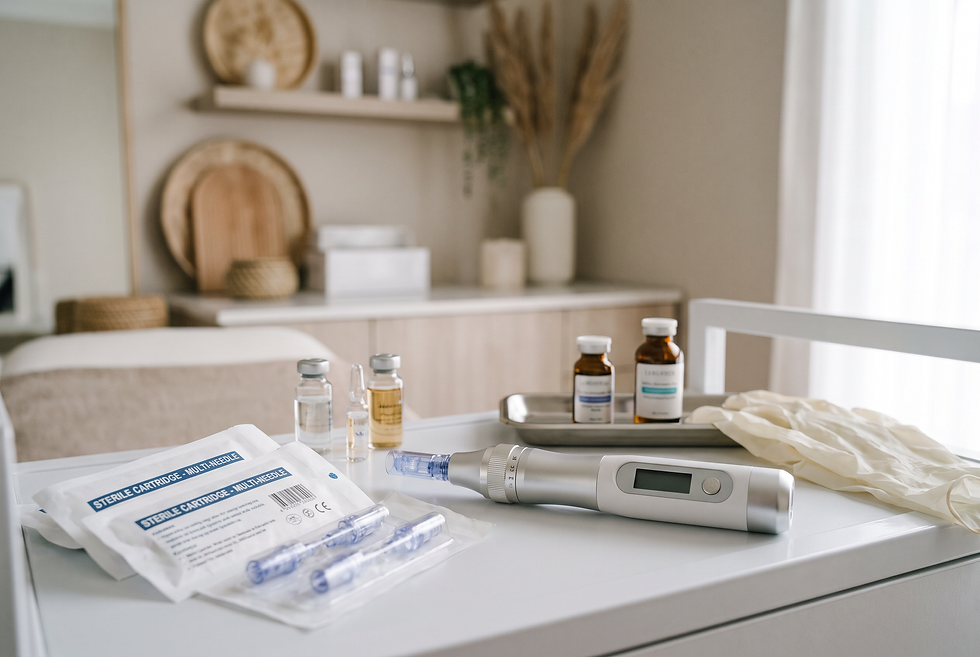
Step 1: Obtain Crucial Identifiers from the Manufacturer
Before accessing federal databases, request the following specific details from your supplier:
510(k) Premarket Notification Number (format: K followed by six digits, such as K123456)
Applicant / Owner Name (the exact legal entity registered as the clearance holder)
Proprietary / Trade Name (the exact device model name submitted on the clearance document)
Product Code (three-letter code, such as QHI, PBX, or GEX)
FDA Establishment Registration Number / FEI Number
Device Listing Number (format: D followed by six digits)
Step 2: Search the 510(k) Premarket Notification Database
Navigate to the official FDA 510(k) Premarket Notification Database on the FDA website. Input the 510(k) number provided by the supplier. Once the record loads, verify the following details:
Applicant Match: Ensure the legal entity matches the manufacturer or that a clear, documented legal authorization links your supplier to the applicant.
Trade Name: Confirm that the device model name listed on the 510(k) summary corresponds to the unit you are purchasing.
Indications for Use: Review the Summary statement (PDF) linked in the database record. Ensure that the clinical indications approved by the FDA match your intended marketing strategy in the US market.
Step 3: Confirm Establishment Registration and Device Listing
A 510(k) clearance alone is not sufficient to clear US customs. The foreign manufacturing facility must maintain an active registration, and the specific device must be actively listed.
Access the FDA Establishment Registration & Device Listing Database and enter the manufacturer's name or FEI number. Confirm that:
The facility's registration status is marked as Active for the current fiscal year.
The specific microneedling system is listed under the manufacturer's active product listings.
The listed owner/operator has paid the annual FDA establishment user fee.
Step 4: Check the FDA Import Alert & Detention Database
Check whether the supplier or specific product code is subject to an active FDA Import Alert (such as Import Alert 89-08 or 66-41). Importers should review the FDA Import Alerts Database to verify that the manufacturer is not subject to "Detention Without Physical Examination" (DWPE).

Step 5: Inspect Device Labeling and UDI Readiness
Class II medical devices distributed in the US must comply with FDA 21 CFR Part 801 labeling requirements, including the Unique Device Identification (UDI) system. Confirm that:
The physical device label includes the manufacturer's name, model number, serial number, and UDI barcode.
The product labeling, user manuals, and packaging do not include unapproved therapeutic claims exceeding the 510(k) summary statement.
Regulatory Document Matrix: What Each Document Proves
To help compliance teams evaluate incoming documentation, the table below highlights the purpose, database source, and validity checks for each critical regulatory asset:
Regulatory Asset | Purpose & Scope | Verification Database | Critical Validation Check |
510(k) Clearance Letter | Confirms the device is substantially equivalent to a legally marketed predicate device. | FDA 510(k) Database | Match the 6-digit 'K' number, trade name, and cleared indications for use. |
Establishment Registration | Proves the manufacturing site is officially registered with the FDA. | FDA Establishment Registration Database | Verify status is current for the ongoing calendar year and fees are paid. |
Device Listing (Form 2892) | Identifies specific commercial models manufactured at the facility. | FDA Device Listing Database | Confirm the specific microneedling model and product code are listed. |
Declaration of Conformity | Validates testing standards (IEC 60601-1, ISO 10993 biocompatibility). | Independent Accredited Testing Labs | Request complete test reports from ISO 17025 accredited laboratories. |
UDI / GUDID Record | Tracks medical devices through distribution and healthcare channels. | AccessGUDID Database | Confirm DI (Device Identifier) is published and matches physical product labeling. |
Common Red Flags in Supplier Documentation
During pre-shipment verification, compliance teams frequently encounter misleading documentation. Watch out for these common warning signs:
"FDA Registered" Presented as "FDA Cleared": A facility registration simply means the factory registered its address with the FDA. It does not mean the device itself has received 510(k) clearance.
Third-Party Registration Certificates: Private third-party agencies often issue ornamental "Certificates of FDA Registration". The FDA does not issue or recognize paper certificates. Only records in the official online database are valid.
Name Mismatches: If the clearance belongs to Company A, but your purchase invoice is with Company B, you must verify the official contract manufacturing agreement or private label specification developer relationship.
Predicate Mismatches: Ensuring that the 510(k) cited is actually for a microneedling or RF device, and not an unrelated Class I cosmetic tool.
Partnering with Qualified Aesthetic Equipment Manufacturers
When sourcing professional aesthetic technologies—including advanced RF microneedling, diode lasers, and HIFU systems—working with experienced B2B OEM/ODM partners simplifies international supply chain compliance.
Professional manufacturers like Stellayjoy support distributors, clinics, and MedSpas worldwide by providing transparent technical documentation, robust engineering standards, and private label customization to help partners navigate global distribution channels successfully.
FAQ
What is the difference between FDA registration and FDA 510(k) clearance?
FDA registration is an administrative requirement where a manufacturing facility notifies the FDA of its operations and pays an annual fee. FDA 510(k) clearance is a rigorous premarket review demonstrating that a Class II medical device is substantially equivalent to a legally marketed predicate device in safety and efficacy.
Can I import a microneedling device if only the factory is registered?
No. If the microneedling device is categorized as a Class II medical device making clinical or dermal penetration claims, importing it without an active 510(k) clearance and active device listing will likely result in US Customs and Border Protection (CBP) detention and FDA refusal of admission.
How do I check if a microneedling device 510(k) number is genuine?
Visit the official FDA 510(k) Premarket Notification Database online. Enter the 510(k) number (starting with 'K') to review the cleared manufacturer name, proprietary device name, date cleared, and the official 510(k) Summary PDF document.
Do RF microneedling systems follow the same clearance process as manual pens?
RF microneedling systems are Class II medical devices but require distinct electrical safety (IEC 60601-1), electromagnetic compatibility (EMC), and thermal safety testing under specific FDA product codes due to the integration of radiofrequency energy.
Streamline Your Aesthetic Device Sourcing and Compliance
Looking for reliable OEM/ODM aesthetic equipment manufacturing? Contact Stellayjoy today to discover our professional RF microneedling, diode laser, and HIFU systems built for global B2B distribution and private label success.


