
The Intelligence Shift: A Comprehensive Guide to AI in Beauty Clinics for 2026

The medical aesthetic landscape is currently undergoing its most significant evolution since the invention of the laser. We are moving beyond "Aesthetic 3.0" (manual precision) into "Aesthetic 4.0" (digital intelligence). In 2026, the integration of AI in Beauty Clinics is not merely a trend—it is a fundamental shift in clinical methodology, diagnostic accuracy, and patient trust.

1. Augmented Intelligence: Beyond Human Subjectivity
As highlighted in recent clinical reviews (Ref: PMC), AI is moving from being a "tool" to an "augmented partner." The primary value of AI in Beauty Clinics is its ability to remove human subjectivity and the "fatigue factor" from clinical assessments.
Pattern Recognition vs. Human Eye: While a skilled practitioner can spot surface-level aging, Deep Learning algorithms (Convolutional Neural Networks) can analyze over 10,000 skin data points in seconds, identifying patterns of vascular inflammation or early-stage dyschromia that are invisible to the naked eye.
Standardizing Excellence: AI ensures that every patient receives a "Gold Standard" consultation, regardless of whether they are seen by a senior doctor or a junior technician. This standardization is the key to clinic scalability in 2026.
2. Advanced Computer Vision in Diagnostic Precision
The first pillar of AI in Beauty Clinics is diagnostic excellence. Modern AI skin analyzers are no longer just cameras; they are sophisticated computer vision hubs.
Predictive Analytics: By analyzing a patient’s current skin health against massive datasets of various ethnicities and ages, AI can generate a "Skin Aging Forecast." This data-driven visualization allows clinics to pivot from reactive treatment (fixing problems) to proactive preventive care (prejuvenation).
The Conversion Multiplier: According to industry reports from Professional Beauty, when patients are presented with quantitative "Bio-Metric" data rather than just an opinion, treatment plan adherence increases by up to 45%. AI provides the "proof" that patients need to justify high-ticket investments.
3. Automation and Robotics: The Future of Treatment Delivery
The next frontier of AI in Beauty Clinics involves the marriage of intelligence and hardware. Automation is the answer to the global shortage of skilled medical labor.
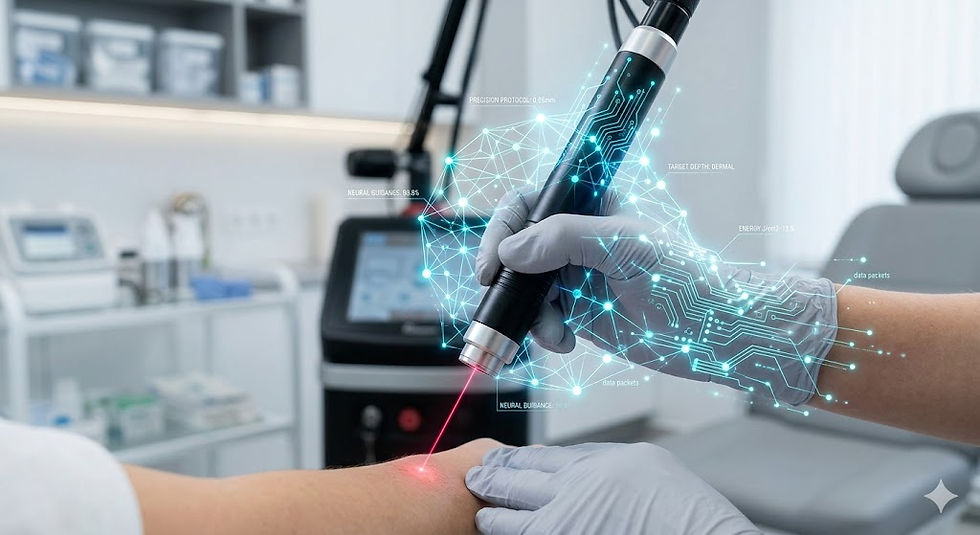
Robotic Path Planning: Advanced laser and RF platforms now feature AI-guided robotic arms. These systems scan the treatment area in 3D, calculating the optimal energy delivery path to ensure perfect uniformity. This eliminates "overlap burns" and "missed gaps," ensuring a level of safety that manual operation cannot match.
Parameter Autopilot: We are seeing the rise of "intelligent energy." Devices can now monitor skin impedance and thermal response in real-time, adjusting the pulse width and fluence milliseconds before the skin reaches its thermal damage threshold. This is the ultimate safeguard against complications.
4. The Ethical Pillar: Privacy and Inclusivity in AI in Beauty Clinics
As the digital transformation accelerates, the long-term success of AI in Beauty Clinics hinges on a foundation of transparency and ethics. Beyond the technical brilliance of the algorithms, practitioners must proactively manage the responsibilities that come with handling sensitive biological data.
Data Sovereignty & Patient Confidentiality: In the age of digital aesthetics, high-resolution facial mapping and skin profiles are among the most sensitive forms of personal data. To foster trust, it is imperative that AI in Beauty Clinics operates within strict compliance frameworks such as GDPR or HIPAA. Implementing end-to-end encryption and secure localized storage is no longer a "technical feature"—it is a fundamental requirement for protecting patient privacy and ensuring the clinic’s legal integrity.
Eliminating Algorithmic Bias for Universal Safety: A major milestone in the 2026 evolution of AI in Beauty Clinics is the industry-wide move toward inclusive datasets. Historically, early AI models often struggled with "darker phototypes" (Fitzpatrick IV-VI). Modern clinics now prioritize diagnostic tools trained on globally diverse skin profiles. This ensures that energy recommendations and skin health forecasts are equally accurate and safe for all ethnicities, preventing the risk of under-treatment or thermal injury in patients of color.

Frequently Asked Questions (FAQ)
Q1: How does AI enhance the "Virtual Consultation" experience?
A: AI-powered "Virtual Try-On" tools use advanced 3D rendering to simulate the results of fillers, toxins, or laser resurfacing. This manages patient expectations effectively, significantly reducing post-treatment dissatisfaction by providing a realistic goal.
Q2: Does the use of AI in clinics reduce the "Human Touch"?
A: On the contrary. By automating the data-heavy diagnostic and treatment delivery phases, AI frees up the practitioner to focus on the "Artistry" and the "Empathy" parts of the consultation—the aspects of beauty that machines cannot replicate.
Q3: Can AI actually predict the risk of post-inflammatory hyperpigmentation (PIH)?
A: Yes. By analyzing vascularity and past skin reactivity data, AI can assign a "Risk Score" to certain treatments. This allows the practitioner to adjust the AI in Beauty Clinics parameters to a more conservative level or include pre-treatment skin priming to prevent PIH.
Q4: Is the ROI of AI technology immediate for a small clinic?
A: While the initial investment is significant, the ROI is driven by three factors: 1) Increased consultation conversion rates; 2) Reduced labor costs through automation; and 3) Enhanced patient retention through data-backed skin tracking.
Conclusion: Reliability Meets Intelligence
In 2026, the question is no longer if you should integrate AI, but how fast you can adapt. The future of AI in Beauty Clinics is about more than just technology—it is about providing a safer, more transparent, and highly personalized medical experience.
[CTA: Is your clinic 4.0 ready? Download our "Complete Guide to Aesthetic AI Integration" and see the 2026 benchmarks for diagnostic accuracy.]


